

The Feeding Of The 4000
- Deacon Dan DeLuca
- Dec 4, 2024
- 4 min read
At the end of his Gospel, Saint Matthew recalls how Jesus commanded his disciples to go forth to all nations, baptizing and teaching them. This exhortation, known as the Great Commission, is essential to the Christian life. Our faith is a faith of evangelization, of bringing the Lord’s message of salvation to all people. Our Lord demonstrates this for us as we hear in today’s Gospel.
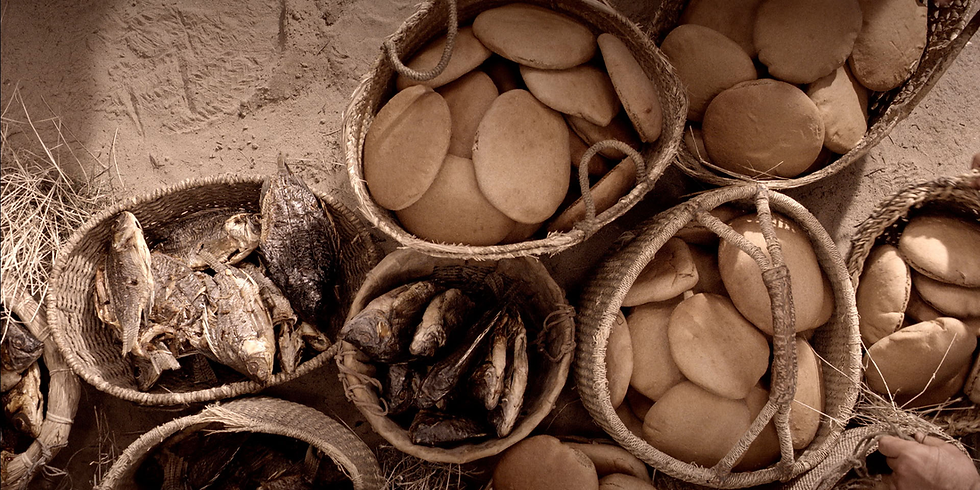
Gospel - Matthew 15:29-37
At that time:
Jesus walked by the Sea of Galilee,
went up on the mountain, and sat down there.
Great crowds came to him,
having with them the lame, the blind, the deformed, the mute,
and many others.
They placed them at his feet, and he cured them.
The crowds were amazed when they saw the mute speaking,
the deformed made whole,
the lame walking,
and the blind able to see,
and they glorified the God of Israel.
Jesus summoned his disciples and said,
"My heart is moved with pity for the crowd,
for they have been with me now for three days
and have nothing to eat.
I do not want to send them away hungry,
for fear they may collapse on the way."
The disciples said to him,
"Where could we ever get enough bread in this deserted place
to satisfy such a crowd?"
Jesus said to them, "How many loaves do you have?"
"Seven," they replied, "and a few fish."
He ordered the crowd to sit down on the ground.
Then he took the seven loaves and the fish,
gave thanks, broke the loaves,
and gave them to the disciples, who in turn gave them to the crowds.
They all ate and were satisfied.
They picked up the fragments left over–seven baskets full.
Scriptural Analysis
This passage opens with a summary of Jesus’ activities. It is similar to such summaries found elsewhere in Matthew’s Gospel with one crucial distinction. This passage mentions explicitly that in response to the miracles that Jesus works, the people “glorified the God of Israel.” This suggests that these people were, at least in large part, Gentiles.
In Chapter 14 of Matthew’s Gospel, we heard of the feeding of the 5000. Now, we see Jesus feed 4000. The miracles are nearly identical in presentation, with only the details differing: 4000 men as opposed to 5000 men, seven loaves as opposed to five loaves, and seven baskets of leftovers instead of twelve. The details of the two miracles provide a clue into their timing, strengthening the argument that these were indeed two miracles. The feeding of the 5000 recalls the people reclining in the grass, indicating springtime. The feeding of the 4000 mentions that the people sat on the ground. This shows it was likely high summer when the grass was scorched, and only the dirt remained.
Between these two miracles, Jesus was journeying in the North for about six months. We know very little about what occurred during that time. However, it is likely that this period when Jesus and his disciples were withdrawn from the public was significant. It was a time for Jesus to instruct and strengthen his disciples for what would come. It would be tempting to interpret this miracle in the same way one interprets the feeding of the 5000. However, there is a distinct difference between the two that is important to understand.
Unlike the feeding of the 5000, which was composed of Jews, the 4000 was likely composed of Gentiles. We can reason to this based on the location of the miracle, the eastern side of the Sea of Galilee. This region falls in the area of the Decapolis, which is a grouping of predominately Gentile cities. Second, this miracle follows the encounter with the Canaanite woman where she stated that “even the dogs eat the crumbs that fall from their master’s table.” (Matthew 15:27). The point of that encounter was to show that even the Gentiles are granted a share of the bread that God is giving the Israelites. The first multiplication was the feeding of Israel; the second was the crumbs taken up by the Gentiles. Third, the number seven is significant. In the first miracle, the 12 baskets signify the twelve tribes of Israel. In the second miracle, the seven baskets point to the idea that Canaan was originally a land of “seven nations” (Deuteronomy 7:1) before the Israelites inhabited it. Matthew may have also intended this link when he described the woman in the previous section as a Cannanite.
One additional clue further strengthens the argument that these were indeed two events. In the feeding of the five thousand, the baskets used to take up the fragments are called kophinoi; in the feeding of the four thousand, they are called sphurides. The kophinos was a narrow-necked, flask-shaped basket that the Jews often carried to ensure they would not have to eat unclean food. The sphuris was a much larger basket, potentially large enough to hold a man. This was a kind of basket that a Gentile would use.
Daily Application
The message of these events is quite clear: Jesus came to save all people, not just the Jewish people. While the Gospel can sometimes present this as a new concept, it is not. The Jewish people were always intended to bring the truth of who God was to all the nations, not keep it to themselves. Over time, they turned inward and lost sight of that. Christ reminds them of this and demonstrates it through his outreach to the Gentiles.
Are we much different than the Jewish people at the time of Christ? Are our parishes focused inward, or are they focused outward? Take an inventory of the events that are on the calendar and classify them. Now, I am not saying that these inward events are bad. Our children need to be prepared to receive their sacraments, and we need continuing formation for our adults. However, when we look at the calendar, and 95% of all parish events are for the parish, perhaps we are out of balance.
In his Apostolic Exhortation, Evangelii Gaudium, Pope Francis says that he prefers, “A Church which is bruised, hurting and dirty because it has been out on the streets.” (49) Perhaps this can provide a paradigm through which we can examine our parishes and that actives we are engaged in. Do we resemble the image that Pope Francis lays out? Are we bruised and dirty because we have been out, sharing the Gospel message?


Comments